Showing posts with label Website. Show all posts

2013/08/15

Flak Photo's Making Pictures of People


Photographs by Doug Dubois, Simon Roberts, Cara Phillips, Richard Renaldi, Matt Eich and Jim Mortram.


The screen grabs above are from Flak Photo's online exhibition Making Pictures of People. It was produced in conjunction with the physical exhibition About Face: Contemporary Portraiture, at the Nelson-Atkins Museum of Art. Visitors at the exhibition will be able to see this digital exhibition on screens.

I have only looked at the online show briefly on an iPad and laptop, but I've been very impressed with the navigation, content and how well it works on a tablet. Why am I featuring a website on this blog you might ask yourself? Well, there's basically not any difference from apps/ebooks, apart from the fact that you're using an url instead. Considering the current mess with different, limiting and non-universal ebook and app formats, in many cases it might be a better option to make curated project websites like this one.

I hope Andy Adams of Flak Photo and his team will continue producing these excellent websites. It's a great follow up to Looking at the Land, and it's not hard to see that a lot of time, thought and dedication went into this. 
Now, I will continue looking. Highly recommended.

2013/06/01

Five Questions to Rory Blain, Director, Sedition


Hi Rory, can you tell us briefly about Sedition?

Sedition is the leading platform used by the world's most renowned contemporary artists to distribute art digitally to connected devices and screens. We offer works by Damien Hirst, Shepard Fairey, Tracey Emin, Jenny Holzer, Yoko Ono, Elmgreen & Dragset, Bill Viola among many others. Our mission is to change the art world by making art affordable and universally accessible.


Transfiguration by Matt Pyke. Full HD video at Sedition. © Matt Pyke & Realise Studio


I've been following Sedition with great interest for a while. Recently you opened up the platform so that artists can announce their interest, and if invited, submit works for approval. This made it possible for me to launch the 133 Seconds edition on your platform. For that I’m thankful, because now a new output medium is available to me. Is this is how you partly see yourself, as a new output medium?

Yes, we see it as a new opportunity for artists to distribute their work – the internet offers an opportunity to reach a vast new audience, and at a much more affordable price. It is very easy for anyone to put their work up on a blog, social media or Youtube, but there is no way for artists to control the distribution and to ensure the highest quality for their followers and collectors. For artists interested to submit work to Sedition, please visit: http://www.seditionart.com/submit.


For digital artworks or video art, I think cloud-based collector platforms, as your own, will be part of the future. The move away from hard-drives and discs seems logical, as that's the direction the whole world is slowly moving in. If Sedition will be THE platform remains to be seen, but your platform is certainly the first major one. What are your thoughts on the future and how do you think you can improve?


We feel people do not need to have their work on a local desktop, but rather make it available anywhere, anytime and on any device, whether it’s a TV, smart phone, tablet or computer. We are constantly looking for ways to improve and will never be finished! There are too many projects to list but the first is to expand the kind of work we can offer. Currently we support hi-res images and videos, so something we want to develop is the ability to support generative or interactive artworks.


As an artform, photography has always been seen and collected as prints and books. With cheaper, better quality and higher resolution displays, photography is looking better than ever on the screen. You’re selling photographs in digital format, so what role do you think photography will play on the screen?

Today, photography is primarily digital and cameras are only getting better with higher resolution images – this improves the viewing experience of photographs on the screen. The hardware is also improving such as Smart TVs and iPads retina displays, which also help in creating the best experience for displaying photographs on screen.


Entrance by Wim Wenders. High-resolution image, 3000x2318px at Sedition. © Wim Wenders


Three works I like at Sedition are Entrance by Wim Wenders, Track Record by Darren Almond and Flight Patterns by Aaron Koblin. Can you tell me three of your favorites?

It is difficult to select only three as we like them all! If I would have to pick just three, I would choose: Damien Hirst’s ‘For Heaven’s Sake’, Lee Lee Nam’s ‘Dreamscape 2’, and Matt Pyke’s ‘Transfiguration’.


2012/10/26

PDF Catalogues by Wolfgang Tillmans


From the Moderna Museet online exhibition catalogue.


It's great to see that Wolfgang Tillmans offer free downloads of many of his exhibition catalogues and for example his "Wako" books at his website. If you aren't able to see his exhibitions or own the Wako books, you at least get a taste of them by looking at the PDFs.

2012/09/27

Online Editions by Fazal Sheikh


From top: 1. "The Victor Weeps",  2-3. "Moksha" and 4-5. "The Circle". The images are laptop screen grabs.
Photos Copyright © Fazal Sheikh


"Fazal Sheikh is an artist who uses photographs to document people living in displaced and marginalized communities around the world. His principle medium is the portrait, although his work also encompasses personal narratives, found photographs, sound, and his own written texts. He works from the conviction that a portrait is, as far as possible, an act of mutual engagement, and only through a long-term commitment to a place and to a community can a meaningful series of photographs be made. His overall aim is to contribute to a wider understanding of these groups, to respect them as individuals and to counter the ignorance and prejudice that often attaches to them. 
Each of his projects is collected and published and is exhibited internationally in galleries and museums. He also works closely with human rights organizations and believes in disseminating his work in forms that can be distributed as widely as possible and can be of use to the communities themselves.
Over the past decade, Fazal Sheikh has made all his projects widely available over the Internet. This website is, therefore, a record of his work to date and constitutes an online exhibition, a publishing resource, and an archive."  Fazal Sheikh's website


Format: Website

Price: Free

Link: Fazal Sheikh

Comment: Fazal was kind enough to let me use some screen grabs of his "Online Editions".
Making his publications available online in different languages is a great way of making the work available to not only collectors of his books, but maybe hopefully also to a small part of the very communities/areas he works in, and of course to the rest of the world.
Make sure you have a lot of time on your hands before clicking any link that leads to his website, because there's a lot to see and read, and it's good.

FYI: Sheikh's show "Ether" is currently on view at the Pace/MacGill Gallery in New York, until October 20.

2012/09/03

Five questions to Matt Johnston of The Photobook Club


First, what is the The Photobook Club?

The goal is to create a space for people to share their thoughts on photobooks as well as to promote the physical book and experience of looking/reading in itself. That space lives online at the photobookclub.org where we choose individual books to look at over a given month and invite others to add their thoughts, but it also lives in the physical world as book clubs. The first of these I ran at the London Photobook Festival back in 2011 and since then I have been organising more myself as well as helping others to set up their own Photobook Clubs around the world - there are currently 6 permanent clubs who meet once a month as well as others who run one-off events and many more who are planning to launch before the year is out. The popularity highlights the level of interest in the physical book as well as in getting together to share that experience but it's also worth remembering that a lot of these events are enabled by digital technology in the form of websites, Twitter and Facebook.

Through the online presence, book clubs and now digital publishing I hope that the Photobook Club as a whole is helping more people see more photobooks, and to enter into dialogue about them regardless of their experience or knowledge.


How did you first come in contact with the photo book Invisible City and Ken Schles?

I first came into contact with the book via an open class I work on with Jonathan Worth at Coventry University. The free class called #phonar (Photography and Narrative) was drawing to a close for the term and with the success of a guest post by Wayne Ford listing some of his favourite narrative photobooks we decided to approach other contributors, photographers, publishers and the like to submit their own suggestions. Only a few books appeared more than once as Invisible City did* and so I was curious to check it out. Unfortunately it's popularity and scarcity became quickly apparent but I managed to see a portion of the book online, it was a short while later that Ken and I began to exchange emails about the possibility of a special Photobook Club feature on the book with the author taking part. It wasn't until a few months later when I met with Ken in New York that I finally got my hands on the book and began the project (to which I owe a huge amount of thanks to Ken for his participation and of course initially for the trust and loan of his own copy).

*Jeff Brouws and Steve Pyke who both nominated the book to the #phonar book list have written their own personal reflections featured in 'Invisible City, A Digital Resource'


Why did you decide to publish Invisible City, A digital resource, and why digitally?

In a nutshell, both Ken and I wanted to realise the project as a way to introduce a new audience to this work, but also to give added value to those who were already familiar with the book in it's physical form. Since it's birth in 1988 as a $20 hardback it has taken on an interesting life of it's own to a point where you struggle to get hold of a copy for less than $800 second hand, and so in part I was also trying to understand this strange life and perhaps even demystify it a little.

When I first started thinking about how I could showcase this work it seemed such a shame to simply create a digital translation, instead I went about creating something that would be of interest not only to those coming to the book for the first time but also those who had a copy, or who had seen it hundreds of times. With Ken's help we could feature scans of his lecture notes from 1990 at the ICP, a video showcasing a handmade alternate version, his own thoughts on the books history and personal reflections from people who have known the book. Doing this digitally meant that it could be distributed for free and that all the rich content we had gathered, could be embedded within one artefact, I think it also makes clear that it is in no way an attempt to replace or to compete with the generative experience that having the book in your hands, brings.


Will we see more digital publications from you in the future?

Absolutely, for starters I will be releasing an ePub/enhanced PDF version of the 'Invisible City' book. It was never an intention for the book only to be available on iPad but just as I was keen to enhance rather than copy the physical book for a digital experience, I do not want to simply 'port' it onto other devices with which we interact in different ways.

Beyond this there are other photobooks I would love to work with in a similar manner and I am also looking out for projects and artists who I can work with in really taking advantage and pushing the boundaries of both physical and digital books/apps. This being said I shall keep focus on the Photobook Club - one of the huge advantages of the changes in physical and digital publishing means that we can become occasional publishers of individual works through on demand printing, newspaper print and relatively cheep and easy to use digital options.


You mostly deal with physical books at The Photobook Club, but are there any ebooks or apps you like in particular?

I really love the HP Magcloud app for iPad, there is a vast amount of great content there and all of it is very easy to browse, download and view. As a rich accompaniment to the images and exhibition I think it is quite hard to fault the Burtynsky: Oil app but the project I am most excited about currently is Kadir Van Lohuizen's 'Via PanAm'. The App that was built to showcase this live project was fantastic in itself but now the work is to become a book and I am really keen to see how that unfolds as we are traditionally used to conversions only heading in the other direction. Bas and the team at Paradox are always looking for possibilities rather than problems in publishing so it is definitely one to watch. (I seem to have avoided the question and gotten back to physical books - sorry about that)


If you would like to download 'Invisible City, A Digital Resource' from the iBookstore, click here
You can contact Matt via email matt@photobookclub.org

2012/08/31

Unless you will


Simon Harsent, Issue 21.

Roger Ballen, Issue 12.


Unless you will is an online journal curated and founded by Australian photographer Heidi Romano.
At the moment there are 22 PDF issues for free download, the first one from November 2009 and the latest one published this month. Each issue is a bit like a group show, showing a project from a limited number of photographers.
Apart from good design the editing is very impressive, showing great photography from all over the world, both from emerging talents and established photographers. So if you haven't already had a look, UYW is definitely worth one. Also make sure to visit the blog.

2012/08/27

The physical photo book is also digital

This blog is about digital photo books, but I like the physical books just as much. The physical photo book live as much online, if not more, than they do in peoples homes. There are photo book review sites, tons of photographs and videos showcasing them, libraries, work in progress, crowdfunding to get them made, discussions, online shops and auctions etc.
Below are some great websites and blogs covering the subject in different ways. I know, I probably forgot about a thousand other sites.


Claxton Projects

"The Claxton Projects website is a curated selection of contemporary and vintage photography books from the Claxton Projects library. This archive includes books by some of photography’s most distinguished, imaginative and inventive artists and is intended to provide an introduction to new collectors, whilst highlighting the occasional overlooked title to the more seasoned photography book enthusiast. Above all else, Claxton Projects is a celebration of great photography books and the wonderful images within."


Indie Photobook Library

"Founded by Larissa Leclair in 2010, the Indie Photobook Library is an archive of self-published and indie published photobooks. This includes DIY, photobooks independently published and distributed, photography exhibition catalogs, print-on-demand photobooks, artist books, zines, photobooks printed on newsprint, limited edition photobooks, and non-English language photography books, etc. The iPL promotes and showcases the books in the collection through international pop-up and feature-length exhibitions, articles, conferences, guest lectures, and also preserves them as a non-circulating public library."


One year of books

"We are husband and wife, living in Paris. This blog shows our growing book collection."


Self Publish, Be Happy

"Self Publish, Be Happy is an organisation founded by Bruno Ceschel in 2010 with the aim of celebrating, studying and promoting self-published photo books through events (such as exhibitions, displays and talks), publications and online exposure. Self Publish, Be Happy also organises workshops that help artists and photographers make and publish their own books."


The PhotoBook

"I write reviews and commentaries about photographic books, aka PhotoBooks. The photobooks that are of interest to me are contemporary investigations that cover a broad range of photographic projects, series and monographic subjects. I will occasionally provide news about photographic book publishing and photobook events. My book reviews are provided on a totally random frequency."


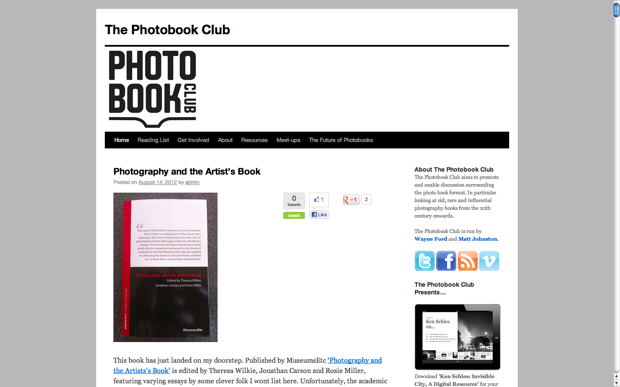
The Photobook Club

"The Photobook Club aims to promote and enable discussion surrounding the photo book format. In particular looking at old, rare and influential photography books from the 20th century onwards.

Each month the Photobook Club will look at one photography book worthy of discussion not only by us at the Photobook Club but anyone who would like to write blog posts, comment through tweets and generally add 2 cents."